Welcome to the Classical and Quantum Nano-Systems Lab at the University of Washington. We study emergent physical phenomena in nanoscale systems from room temperature down to ~10 mK. We are interested in the vibrational properties of 1D molecular strings and electronic properties of 2D quantum materials. Combining tools including micromanipulators and photonics with quantum transport measurements, we observe and control complex physical phenomena that emerge in these systems.
In situ electrostatic control of 2D materials
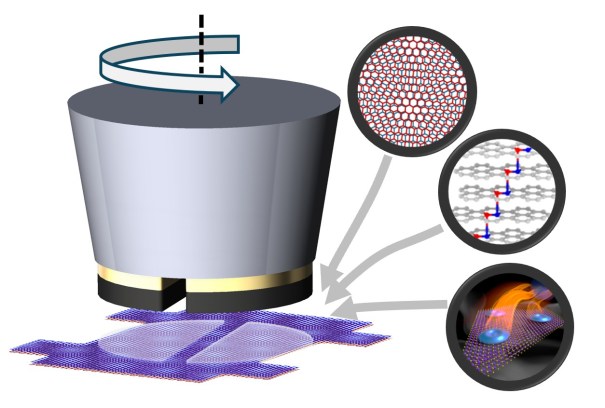
We are interested in correlated electronic states in 2D materials and specifically are working on in situ control of electron-electron interactions in these systems. It is well established that layered 2D materials can produce a wide range of quantum phenomena including superconductivity, and a major effort in materials physics is to understand why. Towards this effort, we have built a one-of-a-kind millikelvin scanning probe microscope that enables us to electrostatically control 2D materials devices, and uniquely control how correlated electronic states form through tuning electron-electron interactions.
*Graduate Student position open*
In situ interlayer shearing of layered materials
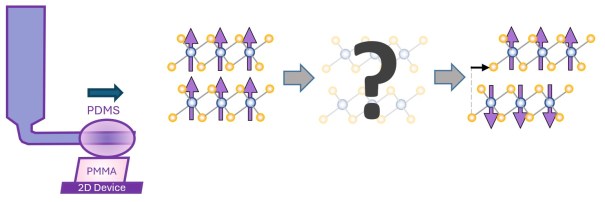
Layer materials have the unique feature of having weak bonding between layers, and thus there are different ways that layers can stack, leading to different electronic or magnetic states. To this end, a natural tuning parameter to study emergent electronic states is to experimentally tune interlayer registry. Our lab has come up with a way of applying shear deformations to 2D crystals to affect their interlayer interactions and thus tune magnetic and electronic states. We currently are focused on “sliding ferroelectrics” including parallel-stacked hBN and WTe2.
*Graduate Student position open*
In situ optomechanical readout of molecular vibrations
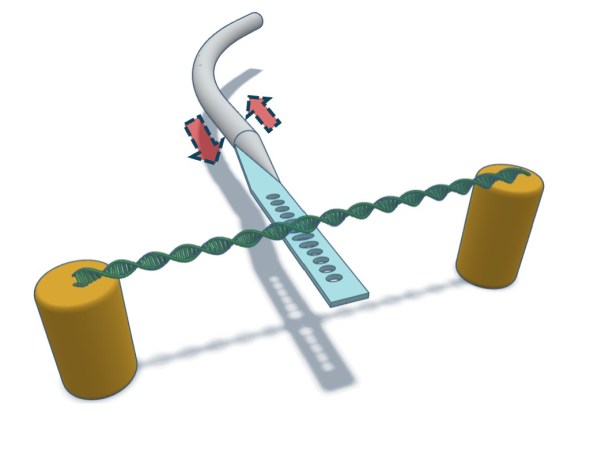
In a more classical domain, we are studying thermal physics of 1D strings. This is an offshoot of our earlier work on thermalization in carbon nanotube resonators, where nonlinear dynamics played an important roll in how energy flows among vibrational degrees of freedom. We’re current studying DNA molecules as a model system, where we can control the sequence to build structure along the 1D string and use photonic cavities as a sensitive detector. With this platform we hope to probe thermalization in the classical and quantum regimes.
Funding
Our lab has been supported by the National Science Foundation. Current funding includes a 2026 NSF CAREER award and participation in UW’s NSF supported MRSEC.

